
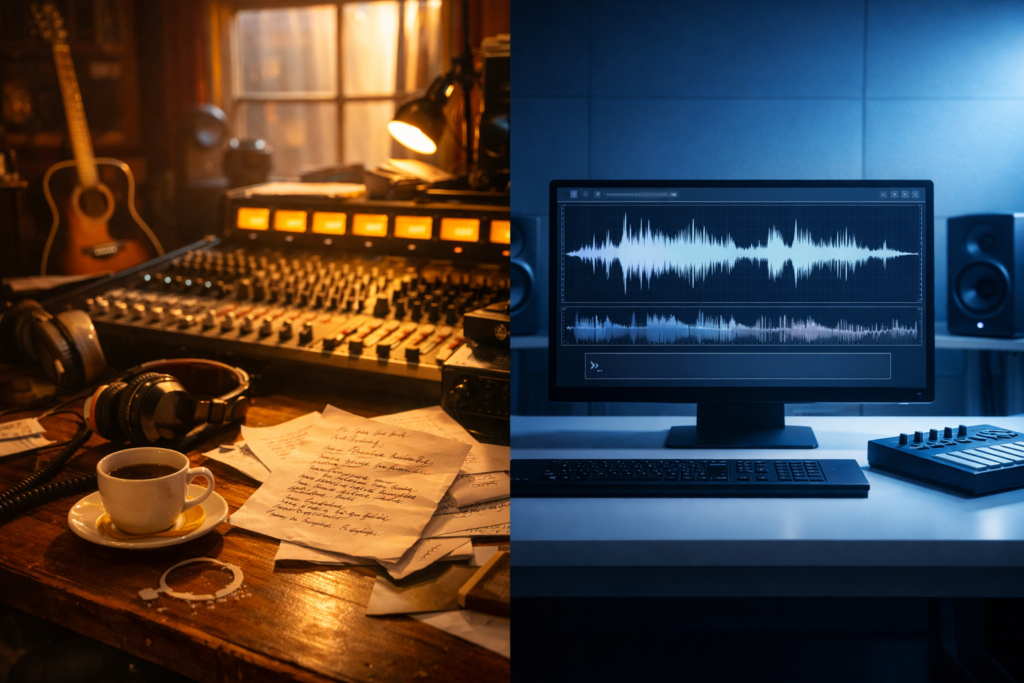
The music industry reached a turning point this week. Bandcamp, the indie music platform beloved by artists and fans alike, announced a total ban on AI-generated music. Not partial restrictions. Not “use with caution” guidelines. A complete prohibition.
This isn’t just another platform policy update. It’s a declaration of values in an industry drowning in algorithmic content, and musicians everywhere are celebrating like they just won back their livelihoods.
Why This Matters More Than You Think
The flood of AI-generated tracks has turned music discovery into a minefield. Imagine scrolling through new releases, finding a song that catches your ear, only to discover it was created by typing a few words into Suno or Udio. No band. No rehearsals. No late nights tweaking that bridge until it finally clicks.
YouTube Music users are already experiencing this nightmare. One frustrated listener described how AI tracks infiltrated their discovery feed so thoroughly that they’ve stopped exploring new artists altogether. The paranoia is real: “Is this AI, or did someone actually make this?” has become the question nobody wanted to ask before hitting play.
Bandcamp’s ban addresses a problem that goes deeper than aesthetic preference. The platform built its reputation on connecting listeners directly with creators, offering artists 82% of revenue from sales while Spotify pays fractions of cents per stream. When AI-generated content floods that ecosystem, it doesn’t just annoy listeners—it actively harms the financial pipeline that keeps independent musicians alive.
The Technical Reality Behind AI Music Detection
Detecting AI-generated music isn’t guesswork. The technology leaves fingerprints that trained ears and analytical tools can identify.
AI music generators like Suno train their models on compressed audio files. This compression creates a specific signature: missing frequencies and degraded audio data that bleeds instruments together in ways human production never would. When you record a guitar, bass, and drums separately, then mix them together, each instrument occupies distinct frequency ranges. AI generates everything simultaneously, creating an eerie blending effect that sounds like digital distortion—similar to aggressive autotune but more synthetic.
Music producer and YouTube creator Benn Jordan broke down these technical tells in a detailed video analysis. He demonstrated how frequency spectrum analysis can confidently identify AI-generated tracks. The tools already exist. The detection process can even be automated using machine learning algorithms, though the irony of using AI to catch AI isn’t lost on anyone.
Beyond the audio itself, AI content reveals itself through surrounding elements. Lyrics filled with clichés. Generic artist bios that read like they were written by a chatbot (because they were). Album artwork featuring the telltale smoothness and anatomical inconsistencies of AI-generated images. Together, these signals create a pattern that’s difficult to hide.
The Enforcement Challenge Nobody Wants to Talk About
Bandcamp’s policy sounds decisive, but implementation raises thorny questions that reveal how complicated this issue really is.
What happens when a musician writes an original song, records real instruments for 99% of the track, but uses an AI-generated drum pattern for one section? Does that count as AI music? What if they sampled a commonly-used drum loop that wasn’t AI-generated but sounds similar to AI patterns? How does the detection system differentiate?
Consider the artist making pointed commentary about artificial intelligence who deliberately includes a brief AI clip mid-song as part of the artistic statement. Does that get flagged and removed, even though the AI usage is the whole point?
The gray areas extend into production techniques musicians have used for decades. Bedroom producers who can’t afford session singers have historically collaborated with other musicians or released instrumental versions. Now some are using AI voice conversion to turn their own vocals into different ranges or genders for demo purposes. This differs substantially from typing “make me a pop song about heartbreak” into a prompt box, but where exactly does Bandcamp draw that line?
The subreddit r/art provides a cautionary tale. Moderators there have repeatedly banned actual human artists, accusing them of using AI when they simply created highly polished digital work. False positives aren’t theoretical concerns—they’re documented problems that damage innocent creators.
Bandcamp acknowledges these challenges by relying partially on user reports and reserving the right to remove content “on suspicion” of being AI-generated. The platform encourages community policing through reporting tools, which works until bad actors start weaponizing reports against legitimate musicians whose production sounds too clean or too unusual.
What Musicians Are Actually Saying
The response from working musicians reveals how deeply AI music has shaken their professional foundations. The top-voted comment on the Reddit announcement was simple: “Good.” Variations on that sentiment dominated the discussion with thousands of upvotes.
One commenter captured the frustration perfectly: “Get a guitar and learn four chords and start a band like the damn punks did 50 years ago. It’s not hard.” The message wasn’t gatekeeping for its own sake—it was defending the fundamental premise that music creation requires effort, skill development, and human connection.
Multiple musicians reported actively hunting down AI-generated content that slipped through Bandcamp’s filters before the ban, submitting reports to clean up the platform. These weren’t casual listeners clicking a button out of annoyance. These were artists protecting their professional ecosystem from degradation.
The concerns aren’t purely aesthetic. When AI-generated music floods streaming platforms and digital storefronts, it creates noise that buries legitimate artists. Discovery algorithms can’t distinguish between a track that took six months to write, arrange, and produce versus one that took six minutes to prompt into existence. Both compete for the same listener attention, the same playlist spots, the same algorithmic recommendations.
Some musicians acknowledged finding AI-generated songs surprisingly good before discovering their origin, then feeling betrayed by that quality. One listener described finding four or five genuinely impressive tracks, only to learn they were AI-created, leading to paranoia about every new artist discovery. The trust breakdown isn’t about snobbery—it’s about wanting to support actual people with your listening time and money.
The Corporate Context You Need to Understand
Bandcamp’s current ownership complicates this narrative. The platform isn’t the scrappy independent operation it once was. Epic Games bought Bandcamp in 2022, then sold it to Songtradr in 2023. That transition brought mass layoffs affecting roughly half the original team, forced artists onto a different payment processor many found inferior, and allegedly drove customer service quality into the ground.
Some artists abandoned Bandcamp entirely. Others made their catalogs free rather than give the new ownership any revenue cut. The platform’s reputation suffered significant damage among the very community it was built to serve.
One cynical but probably accurate take noted that Bandcamp only implemented this AI ban after competing platforms launched with anti-AI policies from day one. Market pressure, not ideological commitment, may have driven this decision. When you’re hemorrhaging user trust and facing new competition, adopting the moral high ground becomes good business strategy.
Despite these corporate complications, musicians largely celebrated the policy change. Even those criticizing Bandcamp’s ownership recognized that banning AI music protects the platform’s core value proposition. If you can’t trust that Bandcamp hosts human-created music, what differentiates it from any other digital music marketplace?
The Bigger Battle Beyond Bandcamp
This ban represents one battle in a larger war over artificial intelligence in creative industries. Similar conflicts are erupting across photography, illustration, writing, voice acting, and every other field where AI tools can generate content that mimics human creative output.
The fundamental question isn’t whether AI can create impressive results. Clearly it can. The question is whether flooding creative marketplaces with AI-generated content serves anyone beyond the companies selling AI tools and the opportunists looking to monetize zero-effort output.
Multiple subreddits have implemented similar bans: r/LofiHipHop updated their policy to ban “all AI slop, not just Gen AI Music.” r/industrialmusic, r/WorldMusic, r/OutlawCountry, and r/MedievalMusic all enacted AI music prohibitions. These aren’t coordinated campaigns—they’re independent communities reaching the same conclusion about protecting their spaces.
The pattern reveals something important: when given the choice, communities built around human creativity consistently reject AI-generated alternatives. Market demand for AI music exists primarily among people who want easy content to monetize, not among listeners seeking meaningful musical experiences.
Some argue this represents shortsighted Luddism, that resisting AI music is equivalent to musicians who rejected synthesizers or drum machines. That comparison misunderstands the fundamental difference. Synthesizers and drum machines are instruments that musicians learn to play. They expanded the sonic palette available to human performers. AI music generators replace the performer entirely.
What This Means for Your Career in Music
If you’re a musician or aspiring to become one, Bandcamp’s policy clarifies which skills matter for building a sustainable career. Platform proficiency doesn’t count. Prompt engineering won’t help. The fundamentals still win: songwriting, instrumental skill, production knowledge, performance ability, and the ineffable human qualities that make music resonate emotionally.
This creates opportunity for anyone willing to invest the time learning actual music creation. While others chase AI shortcuts, you can develop skills that platforms like Bandcamp explicitly value and protect. The competitive landscape just got clearer: human creativity is the product, and platforms are willing to enforce that standard.
For listeners, this ban offers something increasingly rare: a guarantee that your music discovery experience connects you with actual people. When you buy an album on Bandcamp, you’re supporting someone who spent years developing their craft, not someone who spent five minutes typing prompts.
The implications extend beyond music. Every creative industry faces similar questions about AI-generated content. Bandcamp’s decision provides a template: clearly define your values, implement technical detection methods, engage community reporting, and accept that some gray areas will require human judgment.
Ready to Take Your Career Beyond Music Creation? Whether you’re a musician looking to diversify your income streams, a creative professional exploring new opportunities, or someone with skills in audio production, content creation, or digital marketing, HireSleek.com connects you with companies actively hiring for roles that value human creativity and expertise. Browse opportunities in creative industries, tech companies building the next generation of platforms, or marketing agencies that understand the irreplaceable value of human insight. Your unique skills and creative perspective are exactly what employers on HireSleek are searching for.
The Road Ahead for Digital Music Platforms
Bandcamp’s AI ban won’t end the debate over artificial intelligence in music. It simply draws a boundary around one platform’s values and priorities.
Other platforms face the same decision. Spotify shows no signs of restricting AI music, despite user complaints about algorithmic recommendations pushing synthetic content. YouTube Music users report similar frustrations. Apple Music, Amazon Music, and Tidal haven’t announced policies either way.
This creates market differentiation. Artists can choose platforms aligned with their values. Listeners can select services that prioritize human creativity. Competition based on principles rather than just features or pricing represents a rare development in the streaming era.
The regulatory question looms larger. Should AI-generated content carry mandatory disclosure labels? Should platforms be required to separate human-created and AI-generated music into different categories? These decisions affect billions of dollars in music industry revenue and millions of artists’ livelihoods.
One proposed solution gaining traction: requiring AI tools to watermark their outputs. Not visible watermarks that listeners would notice, but embedded metadata that platforms could detect. This would shift enforcement burden from manual reporting to automated detection, reducing false positives while catching more AI content.
The technology exists today. Implementation faces resistance from AI companies that benefit from ambiguity about their outputs’ origins. Legal requirements might force their hand, but legislation moves slowly while AI music generation accelerates rapidly.
Why Human Creativity Still Matters
Strip away the technical details and platform policies, and this debate centers on a simpler question: what gives music value?
If music is just arranged sound waves that trigger dopamine responses, then AI can eventually generate it as effectively as humans. Optimize the patterns, deploy at scale, watch the streaming numbers climb.
But if music matters because it represents human experience translated into sound—someone’s heartbreak, joy, rage, or wonder expressed through melody and rhythm—then AI-generated music is fundamentally hollow. It can mimic the patterns but can’t replicate the source.
Bandcamp’s ban takes a position on that question. Human experience matters. The story behind the music matters. The years spent learning an instrument matter. The late-night jam sessions, the failed bands, the gradually improving demos, the moment when a song finally clicks—all of it matters.
You can’t prompt your way into that depth. No amount of AI sophistication will recreate the specific life experiences that shape how an artist writes, performs, and produces music. The imperfections, the stylistic quirks, the creative decisions that don’t make logical sense but somehow work—these emerge from human consciousness, not optimization algorithms.
This isn’t nostalgia or resistance to change. It’s recognition that art serves a fundamentally human purpose: connection. When you hear a song that perfectly captures how you feel, you’re connecting with another person who felt that way and found words and melodies to express it. That connection breaks when you discover the song came from a machine that’s never felt anything.
Bandcamp’s policy protects that connection. It’s messy, imperfect, and will definitely face challenges during implementation. But it’s a choice to prioritize human creativity over algorithmic efficiency, and in an industry increasingly dominated by data and optimization, that choice matters more than you might think.
The music industry’s future will be determined by thousands of decisions like this one. Every platform, every artist, and every listener decides what they value and what they’ll accept. Bandcamp made its choice clear: human creativity is non-negotiable, and protecting it is worth the complications.
That’s worth celebrating, even if you’ve never uploaded a track to Bandcamp in your life.