
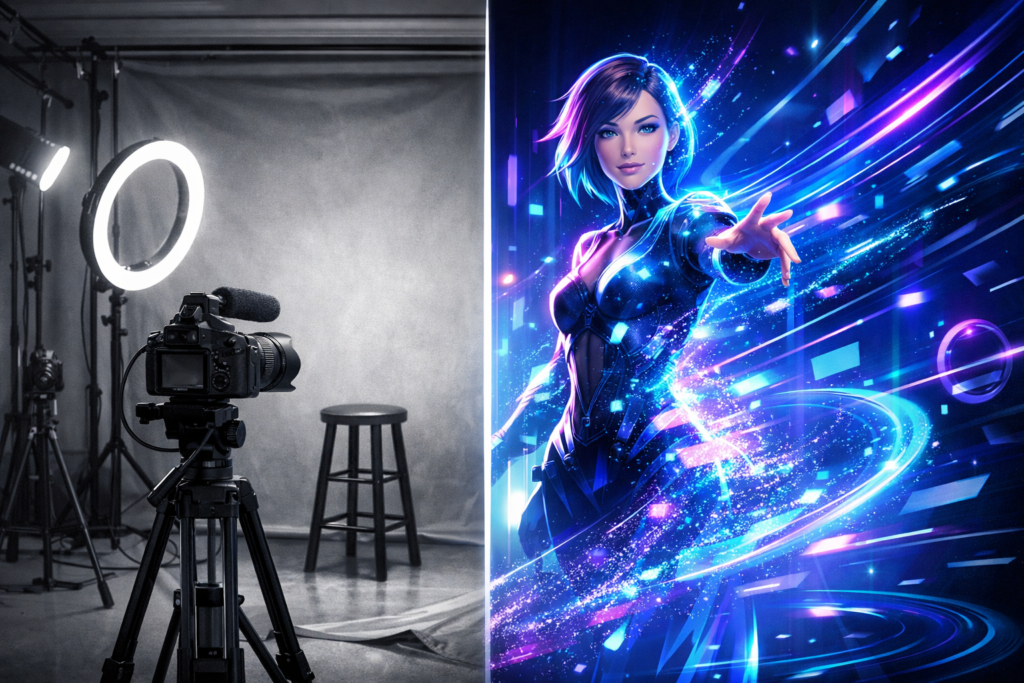
The creator economy just had its iPhone moment, and most people are still using flip phones.
Right now, while you’re reading this, someone is building a virtual influencer that will make more money this month than most real creators make all year. They’re not in LA. They don’t have perfect genetics. They might not even have a camera. What they have is access to tools that fundamentally rewrote the rules of digital fame.
This isn’t science fiction playing dress-up as the future. This is the present moment, happening in real-time across Instagram feeds, TikTok For You pages, and brand partnership negotiations. The barrier to entry for influence just dropped to near-zero, and the implications are staggering.
The Virtual Creator Economy Has Arrived
Meet Dolly, a virtual influencer who broke the algorithm so thoroughly that major brands started booking her over human talent. She doesn’t exist in the physical world, yet she’s built an audience primarily consisting of women aged 18-34 who can’t get enough of her unhinged comedy and brutally honest takes on influencer culture.
Her creator, Muzzy, stumbled into pioneering territory by identifying a massive gap in AI-generated content. While everyone else was creating content tailored to male audiences, Muzzy saw an opportunity to build something different. The result? A character that parodies influencer culture while simultaneously mastering it, flawless on the outside and completely chaotic on the inside.
The numbers tell a compelling story. When asked if Dolly makes more than a doctor, Muzzy simply said she “helps pay the rent, the Wi-Fi, and her own attitude.” Translation: this virtual persona generates serious revenue without requiring makeup artists, flights to exotic locations, or perfect sunset timing.
Why Traditional Creators Should Pay Attention
The rise of AI influencers isn’t just about novelty or technological showboating. It represents a fundamental shift in how content gets created, distributed, and monetized.
Speed and cost efficiency are rewriting brand partnership economics. Traditional influencer campaigns require coordinating schedules, booking flights, arranging hotels, hiring makeup artists, and hoping weather cooperates for that perfect golden hour shot. With virtual talent, brands can shoot campaigns in Tokyo and Paris on the same afternoon without anyone leaving their desk.
This efficiency doesn’t just save money. It compresses production timelines from weeks to hours, allowing brands to respond to trends while they’re still trending rather than after they’ve already peaked.
But here’s what matters more than the logistics: consistency becomes frictionless. Real human creators deal with illness, burnout, scheduling conflicts, and the basic reality that you can’t film 24/7. Virtual influencers don’t have these constraints. The creator who masters this technology can produce content at a volume that would hospitalize a traditional influencer trying to keep pace.
The Character Creation Framework That Actually Works
Building an AI influencer isn’t about generating a pretty face and hoping for viral luck. The creators finding success with virtual talent understand something crucial: the internet doesn’t want perfection, it wants character.
Muzzy’s biggest piece of advice for newcomers? Stop trying to build “hot person number four.” The explore page is already drowning in generically attractive faces. What breaks through the noise is distinctiveness that grabs attention within the first two seconds of scrolling.
With Dolly, that distinctiveness came from the human-doll hybrid aesthetic combined with an attitude that makes people stop mid-scroll. The visual hook draws eyes, but the personality converts viewers into followers.
Modern AI influencer creation tools like Hixfield’s Influencer Studio let creators dial in specificity that would have seemed impossible even six months ago. Character type, gender, ethnicity, skin color, eye color, skin condition, age—these are just the baseline settings. The advanced builder goes deeper, allowing customization of face structure, body type, style elements, and even specific features like prosthetic limbs or unique physical characteristics.
The real power lies in consistency. Once you commit to an identity, everything becomes easier. Content creation flows naturally because you’re building a coherent narrative rather than constantly reinventing your character. Brand deals become more straightforward because partners know exactly what they’re getting.
The Lore Strategy Nobody Talks About
Here’s where most new creators stumble: they generate a character and immediately start posting content without establishing any backstory or narrative foundation.
The successful approach involves building lore from the beginning. Take your generated character and place them in different life stages. Create childhood photos. Generate high school era images. Establish a backstory that gives your character depth and history.
Maybe your influencer grew up in Japan before moving to the United States for high school. Perhaps they had a skateboarding accident that led to a prosthetic leg, which became central to their message about resilience and adaptation. The specific narrative matters less than having one that feels coherent and authentic.
This storytelling foundation accomplishes multiple things simultaneously. It gives you content variety—you can reference past experiences, share throwback photos, and build narrative arcs that unfold over time. It creates emotional resonance with audiences who connect with journey and growth. And it differentiates your character in a sea of static, lore-less virtual influencers who feel hollow by comparison.
Motion Control: Where Most Virtual Influencers Fail
Static images can only take you so far. Video content dominates modern social platforms, which means your virtual influencer needs to move convincingly.
This is where the illusion lives or dies. If movement looks robotic or unnatural, viewers immediately clock the content as AI-generated and disengage. The uncanny valley is real, and it’s particularly unforgiving when it comes to human motion.
Muzzy’s approach with Dolly involves specific prompt instructions that make her move like an actual person. But when using motion control systems that map real human movement onto virtual characters, exaggeration becomes essential.
Human movement contains subtleties that video compression and AI processing can diminish. Compensate by making your source movements slightly bigger and more dramatic than normal. Exaggerate the pauses. Hold still for a beat before the punchline. The attitude and personality live in those micro-moments of stillness and sudden motion.
Modern motion control technology has reached impressive sophistication. You can record yourself dancing, gesturing, or demonstrating product use, then map that exact movement onto your virtual character with minimal warping or face distortion. Hair physics, clothing flow, accessory movement—elements that traditionally challenged video generation models—now transfer naturally.
The viral dance video that’s trending this week? Your virtual influencer can recreate it perfectly, maintaining character consistency while participating in the cultural moment.
The UGC Revolution Hiding in Plain Sight
User-generated content has become the dominant advertising format across social platforms. Polished brand productions often perform worse than authentic-feeling creator reviews and demonstrations.
Virtual influencers unlock UGC creation at unprecedented scale and cost-efficiency. Need ten different creators reviewing your moisturizer? Generate them. Want to test which demographic responds better to your messaging? Create characters that represent different audience segments and produce parallel content campaigns.
The production workflow is surprisingly straightforward. Take a reference video of someone applying moisturizer. Extract a keyframe. Prompt the AI to replace the product with your branded version and swap the person with your virtual character. Generate the motion sequence. You now have UGC content ready to run as paid advertising, created in minutes rather than days.
This capability raises obvious questions about authenticity and disclosure, which smart creators are addressing head-on. The virtual influencers finding sustainable success are transparent about their nature rather than trying to fool audiences into thinking they’re human.
If you’re exploring how AI is transforming professional opportunities across industries, HireSleek.com is worth checking out. The platform specializes in connecting skilled professionals with companies at the forefront of technological innovation, including positions in AI development, virtual content creation, and digital marketing. Whether you’re looking to pivot into emerging fields or find talent that understands these new creator economy dynamics, the curated opportunities on HireSleek cut through the noise of traditional job boards.
The Advanced Builder Toolkit
Once you understand the basics, the advanced customization options become genuinely wild.
Want to create an athletic iguana influencer with green skin, purple eyes, a robotic arm, and hyperrealistic rendering? The tools exist to make that vision reality with precise control over every element.
The key is restraint. Changing more than ten settings simultaneously often degrades consistency and control. Better to start with a strong foundation and iterate gradually than to overwhelm the system with contradictory specifications.
The “surprise me” functionality reveals where this technology is heading. Hit that button and you might generate a bee with a prosthetic leg and robotic arm, a stylish ant ready for fashion week, or a lizard dressed for Pilates class. These aren’t your typical influencers, but they represent untapped niches with dedicated audience potential.
The interesting insight isn’t which character is objectively better. It’s that they each feel like different creators with distinct personalities and audience appeal. This diversity lets you match character to scenario rather than forcing one character to serve all content purposes.
The Earning Equation Has Changed
Platform monetization has caught up with virtual creator reality. Hixfield recently launched Hixfield Earn, which operates on a straightforward principle: create videos, post them, accumulate views, get paid.
This direct monetization removes traditional influencer dependencies on brand deals and sponsorships. You’re building an audience and getting rewarded for the attention you generate, regardless of whether you’ve landed partnership agreements.
The economics favor prolific creators who can maintain consistent output. Virtual influencers have a structural advantage here because production constraints that limit human creators simply don’t apply. No filming fatigue. No scheduling conflicts. No personal life creating content gaps.
Who’s Actually Winning Right Now
The early adopters finding success with virtual influencers share common characteristics. They’re not trying to recreate existing influencer templates with AI skins. They’re building genuinely unique characters that offer something the market isn’t already oversaturated with.
They understand that consistency beats perfection. Some videos get minimal views. Others break through and reach massive audiences. The algorithm rewards persistent creators who keep posting rather than those who agonize over making each piece perfect before publishing.
They interact with their audience and adapt based on feedback. Virtual influencers still need human strategic direction. The creators who treat their characters as collaborative projects with their audience rather than top-down content broadcasts are building more engaged, loyal communities.
The Ethical Dimensions We Can’t Ignore
Muzzy raises a concern that deserves serious consideration: AI is evolving so rapidly that many people genuinely can’t distinguish virtual influencers from real people anymore.
This creates ethical complications. When virtual influencers promote products, are audiences fully informed about what they’re seeing? When they build parasocial relationships with followers, what responsibilities do creators have around transparency?
The creators approaching this thoughtfully are being upfront about their characters’ nature. Dolly’s audience knows she’s AI-generated, which actually enhances rather than diminishes the appeal. The parody works because everyone’s in on the joke.
But not all virtual influencers are marketed with that transparency. As the technology becomes more convincing, the line between creative expression and deception blurs in uncomfortable ways.
Where This Goes Next
The trajectory is clear even if the specific destination remains uncertain. AI influencers will become more sophisticated, more realistic, and more integrated into mainstream content ecosystems.
We’re already seeing virtual influencers used for UGC content, modeling, comedy, and education. The next wave likely includes brands creating proprietary virtual ambassadors, short films starring entirely AI-generated casts, and virtual influencers with AI-powered conversational abilities that let them interact with followers in real-time.
Some people will use these tools to replicate what already exists, creating slightly cheaper versions of traditional influencer content. Others will use them to build something genuinely novel, pushing boundaries and creating entirely new content categories.
The opportunity isn’t in being the ten-thousandth person to generate a conventionally attractive virtual model. It’s in being the creator who asks “what becomes possible now that these constraints have disappeared?” and actually builds the answer.
The Implementation Roadmap
For anyone actually ready to experiment with this rather than just reading about it, here’s the practical starting point:
Begin with character design, but focus on distinctiveness over perfection. Give your character visible characteristics that catch attention during scroll. Scars, unique style, unconventional features—these elements make people stop and look.
Build foundational lore before publishing content. Create childhood photos, establish backstory, generate images across different life stages. This narrative foundation gives you content depth and direction.
Start posting consistently without waiting for perfection. The algorithm rewards frequency and persistence more than it punishes individual mediocre posts.
Use motion control to bring your character to life, but exaggerate movements and lean into personality through micro-moments and pauses.
Engage with your audience and adapt based on what resonates. Even with a virtual character, you’re building a community that will guide your content direction if you let them.
The Bigger Picture
The creator economy has always favored people who spotted platform shifts early and adapted faster than competitors. Virtual influencers represent that kind of inflection point.
This isn’t about AI replacing human creators. It’s about expanding what’s possible for people who understand how to leverage these tools strategically. The human creators who will thrive are those who treat AI as a production multiplier rather than a threat.
We’re entering an era where anyone can create a character with its own lore, narrative, and earning potential. That character can grow and evolve independently of the creator’s own physical constraints. It can experiment with content approaches that would be impractical or impossible with traditional production.
The question isn’t whether virtual influencers will become a permanent fixture of the digital landscape. They already are. The question is whether you’re going to be someone who builds in this space or someone who watches others build while wondering what might have been possible.
As these technological shifts reshape creative professions and create entirely new career categories, staying connected to emerging opportunities becomes crucial. HireSleek.com provides that connection point, whether you’re a professional looking to position yourself at the intersection of AI and content creation, or a company seeking talent that understands these new digital dynamics. The platform’s focus on quality over quantity means you’re engaging with opportunities and candidates that actually match your specific needs rather than wading through irrelevant listings.
The tools exist. The audience exists. The monetization exists. What’s missing is your unique creative vision and the willingness to actually start building rather than perpetually preparing.
The early adopters in this space aren’t experimenting anymore. They’re building sustainable businesses around virtual characters that generate real income. The window for being genuinely early is closing, but the window for being strategically positioned remains wide open.
Your move.