
Artificial intelligence gets a lot of attention these days, but most of the headlines focus on the wrong things. We obsess over chatbots, productivity hacks, and whether AI will take our jobs. Meanwhile, the most transformative applications are happening quietly in spaces most people never think about.
I’ve spent years watching the AI industry evolve, and I’ve become convinced of one thing: the true measure of any technology’s worth isn’t how much money it makes or how many tasks it automates. It’s how fundamentally it can restore human dignity and independence to people who’ve been excluded from experiences the rest of us take for granted.
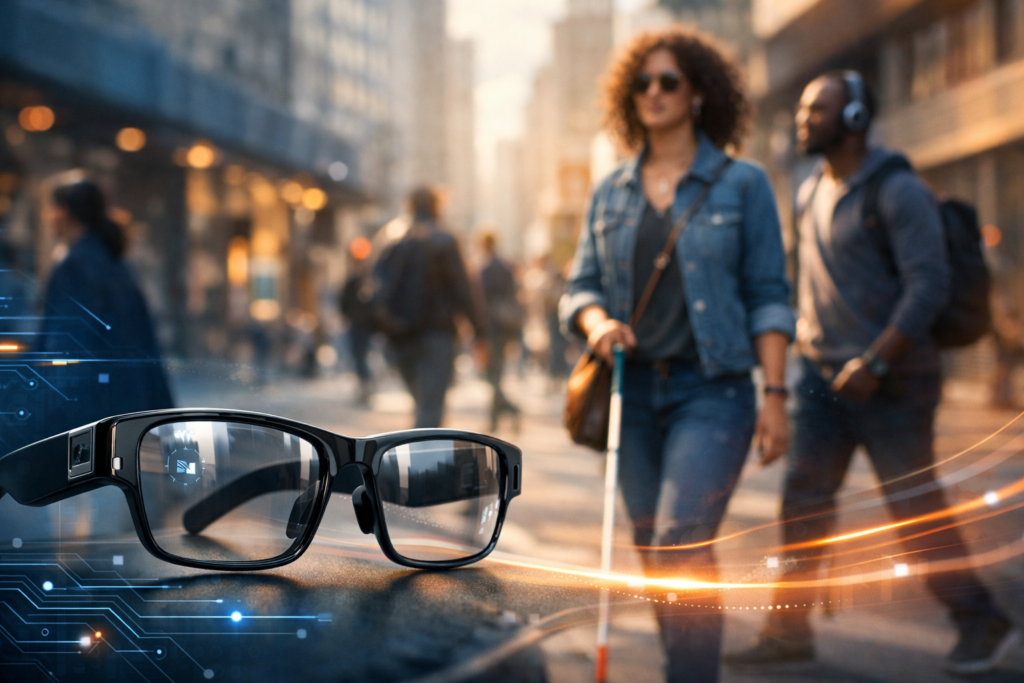
What brought this into sharp focus for me recently was learning about how people with visual impairments are using AI-enabled smart glasses to navigate their world in real time. Not as a futuristic concept, not as a prototype in a lab somewhere, but right now, today, as a practical tool for everyday independence.
This is the AI revolution that matters, and it’s criminally underfunded and under-discussed.
The Translation Layer Between Humans and the Physical World
For most of my career in tech, I’ve watched us build increasingly sophisticated software to handle increasingly abstract tasks. We’ve built AI to write emails, summarize documents, generate images, and analyze spreadsheets. These are useful, sure. But they’re also fundamentally optional.
What I’m seeing now with assistive AI is different. This isn’t about convenience or productivity gains. This is about giving people access to basic human experiences—walking down a street independently, recognizing when someone’s smiling at you, reading a sign, choosing what to buy at a grocery store.
Think about what we’re actually building here: a real-time translation layer between the physical world and human perception. Smart glasses equipped with AI vision can describe surroundings, read text aloud, recognize faces, identify objects, and provide spatial awareness. The AI processes visual information through the camera and converts it into audio descriptions that happen fast enough to be genuinely useful.
This is spatial intelligence meeting assistive technology, and the implications go far beyond what we’re seeing with current applications.
Why Traditional Assistive Tech Has Always Had Limitations
I’ve studied the evolution of assistive technology for years, and one pattern is impossible to ignore: the solutions have always been constrained by their specificity. A cane helps with physical navigation but tells you nothing about what’s around you. Screen readers work for digital content but can’t help you in the physical world. Braille opens up text but requires specialized formatting and doesn’t scale to the millions of signs, labels, and documents we encounter daily.
Each solution solves one problem in one context. The user has to mentally juggle multiple tools, each with its own limitations and use cases.
What makes AI-powered glasses different is their generality. The same device that helps someone navigate a crosswalk can also read a restaurant menu, describe the expression on a friend’s face, identify products on a store shelf, and warn about obstacles in a pathway. It’s not doing one thing well—it’s providing a flexible, context-aware interface to visual information in whatever form it appears.
This generality matters because life doesn’t come in neatly separated categories. You don’t experience “navigation time” followed by “reading time” followed by “social interaction time.” You need all of these capabilities flowing together, and AI is the first technology capable of delivering that integrated experience.
The Gap Between What’s Possible and What’s Funded
Here’s what frustrates me: we have the technical capability to build extraordinary assistive technologies right now. The AI models are there. The hardware is there. The need is absolutely there—there are millions of people with visual impairments who would benefit immediately from this technology.
Yet assistive AI remains dramatically underfunded compared to other AI applications.
Why? Partly because the market is perceived as small, even though approximately 2.2 billion people worldwide have some form of vision impairment. Partly because the people who need these technologies often lack the economic power to make them “attractive” to venture capital. Partly because the tech industry still tends to build for people like themselves—which means young, able-bodied, well-resourced users.
I’ve watched billions flow into AI companies building marginal improvements to productivity software while assistive technology companies struggle to secure basic funding. The disparity isn’t just unfortunate—it represents a fundamental misalignment between where capital flows and where it could make the most meaningful impact.
What Real-Time Spatial Intelligence Actually Enables
Let me get specific about what we’re talking about when we say “real-time spatial intelligence” because this phrase gets thrown around a lot without clarity.
Traditional AI vision can analyze a static image and tell you what’s in it. That’s useful, but it’s not enough for navigation or interaction. Real-time spatial intelligence means the AI is continuously processing visual information, understanding spatial relationships, tracking movement, and providing immediate feedback that’s contextually relevant to what you’re trying to do.
When someone wearing AI glasses approaches a crosswalk, the system doesn’t just say “there’s a street.” It tracks the traffic light, monitors approaching vehicles, assesses the crossing distance, and provides the information needed to cross safely. When they’re in a grocery store, it doesn’t just identify products—it can read prices, check expiration dates, compare options, and help locate specific items.
This is where AI stops being about text generation and starts being about genuine environmental awareness. The technology is functioning as a prosthetic sense, and it’s happening with latency low enough that people can actually use it for real-time decision-making.
The Ripple Effects Beyond Vision Impairment
What excites me most about advances in assistive AI isn’t just the direct impact—though that would be enough to justify the work. It’s that solving hard problems for assistive technology almost always produces innovations that benefit everyone.
Consider curb cuts—the small ramps where sidewalks meet streets. They were designed for wheelchair users, but they now benefit parents with strollers, delivery workers with carts, travelers with luggage, and anyone who’s ever had temporary mobility issues. The same pattern appears throughout assistive technology history.
AI systems designed to describe visual scenes in real time for blind users are developing capabilities that will transform how we all interact with the world. Imagine AR navigation so sophisticated it can guide you through a complex building. Imagine real-time translation not just of languages but of visual information—letting you understand specialized diagrams, interpret complex data visualizations, or navigate unfamiliar environments with expert-level context.
The companies and researchers pushing the boundaries of assistive AI are solving fundamental challenges in computer vision, natural language generation, edge computing, and human-computer interaction. These solutions will cascade into applications none of us have thought of yet.
What Mainstream AI Development Is Missing
The dominant paradigm in AI development right now is to build general-purpose models and then figure out applications afterward. We train massive language models on internet text and then discover they can write code. We build image generators and then find out they’re useful for design mockups.
This approach has produced remarkable results, but it’s also created a gap. The people building these systems aren’t typically thinking about edge cases, specialized needs, or users who interact with technology differently than the typical developer.
What assistive technology development does is flip this paradigm. You start with a specific, high-stakes human need—I need to cross this street safely, I need to know if this medicine bottle is the right one, I need to recognize my friend’s face in a crowd—and then you build the AI capabilities required to meet that need reliably.
This constraint-focused development produces better, more robust AI. When failure isn’t just an inconvenience but a genuine safety risk, you can’t hand-wave away edge cases or blame the user for not prompting correctly. The system has to work, consistently, in unpredictable real-world conditions.
The AI industry would benefit enormously from spending more time in these high-stakes, high-consequence environments. It would make us build better systems for everyone.
The Economic Model That’s Holding Us Back
Let me be direct about something: the reason assistive AI isn’t getting the funding it deserves is that we’ve built an economic model for technology development that prioritizes scale and monetization over impact.
Venture capital wants to fund companies that can reach hundreds of millions of users and generate massive returns. Assistive technology serves smaller, more specific populations and often requires more customization and support. The business model doesn’t fit the standard Silicon Valley playbook, so it gets classified as “impact investing” or “social good”—categories that get a tiny fraction of available capital.
This is shortsighted even from a purely economic perspective. The global market for assistive technology is worth billions and growing as populations age. More importantly, breakthrough innovations in assistive AI will create platform technologies that enable entirely new categories of products for mainstream users.
But beyond economics, there’s a moral dimension here. If we believe AI is as transformative as we claim, then its first and highest use should be restoring capabilities to people who’ve lost them or never had them. The fact that we’ve prioritized entertainment, productivity, and advertising over independence and dignity tells you something about our actual values, not our stated ones.
Five Actionable Developments That Need to Happen Now
Based on everything I’ve learned studying this space, here’s what needs to happen to accelerate progress in assistive AI:
1. Dedicated Funding Mechanisms We need venture funds and grant programs specifically focused on assistive AI, with investors who understand that the value isn’t just in market size but in solving hard technical problems with broad applications. Governments should incentivize this development through procurement commitments and R&D tax credits.
2. User-Centered Development Standards Every major AI lab should have dedicated teams working on assistive applications, with actual users involved throughout the development process—not as an afterthought, but as core design partners. The feedback loop between developers and users needs to be tight and continuous.
3. Open-Source Components Core technologies for assistive AI—object recognition, scene description, spatial mapping—should be open-sourced to accelerate development across the ecosystem. Proprietary advantages can still exist at the integration and user experience layers, but we shouldn’t be reinventing fundamental capabilities at every company.
4. Cross-Industry Collaboration AI companies, hardware manufacturers, accessibility organizations, and healthcare providers need to work together far more closely. The best assistive technologies will emerge from collaborations that combine AI expertise, hardware engineering, clinical understanding, and lived experience.
5. Regulatory Support Without Stifling Innovation We need sensible regulations that ensure assistive AI is safe and effective without creating barriers that only large companies can overcome. This is a delicate balance, but it’s achievable if regulators work closely with developers and users.
Why This Matters for Your Career (Wherever You Are)
If you’re working in AI, computer vision, hardware engineering, product design, or any related field, assistive technology represents both a moral imperative and a career opportunity.
The technical challenges are genuinely hard—real-time processing on battery-constrained devices, reliable performance in unpredictable environments, interfaces that work for users with different needs and preferences. Solving these problems will make you a better engineer and open doors you haven’t imagined.
The market opportunity is real and growing. As populations age and as we recognize that disability is part of the human experience rather than an edge case, demand for sophisticated assistive technology will only increase.
And the impact is immediate and tangible. Unlike many AI applications where the benefits are abstract or incremental, assistive technology produces outcomes you can see: people navigating independently who couldn’t before, accessing information they were excluded from, participating in experiences that were previously impossible.
If you’re looking to apply AI skills where they’ll make a genuine difference, companies building assistive technology need designers, engineers, researchers, and product leaders. HireSleek.com features opportunities from companies working on accessibility and assistive AI—roles where your technical expertise directly translates into restoring independence and dignity. These positions tend to attract people who want their work to matter beyond quarterly metrics, and the technical challenges are among the most sophisticated in the field.
The Stories That Need to Be Told
I started by saying that AI gets attention for the wrong things, and I want to return to that point because it matters how we talk about this technology.
Every breakthrough in AI assistive technology represents a human story—someone who can now do something they couldn’t do before. Someone who gained independence. Someone who reconnected with experiences they thought were lost. Someone who no longer needs to ask for help with tasks most of us don’t even think about.
These stories deserve to be celebrated not as feel-good sideshows but as the main event. They demonstrate what technology is actually for—expanding human capability, reducing barriers, creating opportunities for participation and independence.
When we spotlight AI applications that genuinely restore agency and capability, we’re not just recognizing good work. We’re setting a standard for what the technology industry should be aiming toward. We’re telling engineers and entrepreneurs where to focus their energy. We’re showing investors what deserves funding. We’re demonstrating to the public what AI can be when it’s designed with empathy and purpose.
The woman using AI glasses to navigate her world isn’t a footnote to the AI revolution. She’s the whole point.
Where We Go From Here
The technology exists. The need exists. What’s missing is the collective will to prioritize this work and the economic structures to sustain it.
I’ve watched enough technology cycles to know that change happens when enough people recognize an opportunity and decide to pursue it. The assistive AI space is at that inflection point right now—proven technology, growing awareness, increasing demand, but still dramatically underserved by capital and talent.
The developers, designers, and entrepreneurs who lean into this space over the next five years will build the foundational companies and technologies that define how AI integrates into daily life for billions of people. They’ll solve technical challenges that cascade into mainstream applications. They’ll create business models that prove you can do well by doing good.
And most importantly, they’ll restore independence, dignity, and capability to people who deserve access to the same experiences the rest of us take for granted.
The choice is ours. We can keep building productivity tools and entertainment applications, or we can build technology that fundamentally expands what it means to be human.
I know which one matters more.