
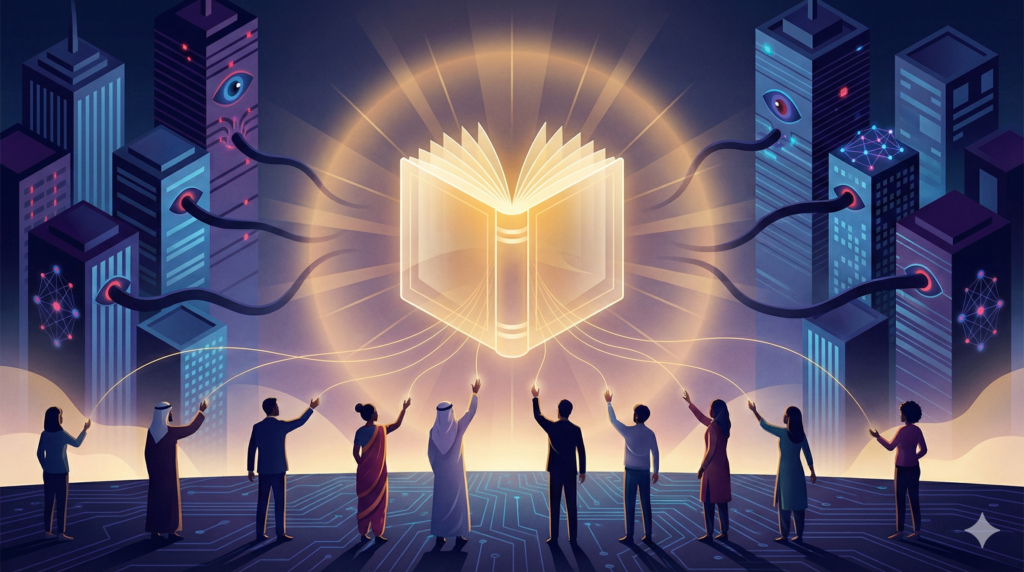
How a Free Encyclopedia Became Humanity’s Digital Lifeline in an Age of AI Surveillance and Information Control
Wikipedia just turned 25, and honestly, it feels like celebrating the last tree standing in a clearcut forest.
While the rest of the internet has morphed into an algorithmic hellscape of paywalls, bot farms, and AI-generated slop, this one platform keeps doing the impossible: providing free, reliable information to over 7 billion monthly visitors without shoving a single ad down your throat.
Let that sink in. Seven. Billion. Visitors. Every month. Zero ads.
In 2026, that’s not just impressive—it’s practically heretical. Every major tech platform has bent the knee to surveillance capitalism, but Wikipedia stands there like that one friend who refuses to sell out, even when everyone else is cashing checks from Big Tech.
The Miracle Nobody Talks About
Most people don’t realize how absurd Wikipedia’s existence actually is. We’re talking about the fifth most-visited website on the planet, running on a budget that wouldn’t cover Instagram’s annual office snack fund. The entire English Wikipedia—all 6.9 million articles—takes up about 150GB with media files. Less storage than your cousin’s iPhone photo library.
The Wikimedia Foundation operates on donations. Not venture capital. Not data harvesting. Not targeted advertising revenue. Actual human beings voluntarily giving money to keep knowledge free and accessible. In an era where everything from your doorbell to your toaster is trying to monetize your existence, this feels like stumbling onto a hidden oasis.
But here’s the thing everyone’s missing: Wikipedia isn’t just surviving against the odds. It’s thriving despite facing existential threats from every direction.
The AI Vampire Problem
AI companies have been treating Wikipedia like an all-you-can-eat buffet, scraping millions of articles to train their language models without attribution or compensation. ChatGPT, Claude, Gemini—they’ve all gorged themselves on Wikipedia’s knowledge base, then turned around and started competing with the very platform that made them possible.
The data tells a brutal story. While internet traffic overall has exploded, Wikipedia’s traffic has actually declined in recent years. People ask ChatGPT instead of searching Wikipedia directly. They trust AI overviews instead of checking the sources. The knowledge gets laundered through chatbots, and suddenly nobody remembers where it came from.
This creates a vicious cycle: fewer visitors means fewer volunteer editors means lower quality content means worse training data for AI means users get increasingly unreliable information. It’s like watching someone slowly poison their own water supply.
The Wikimedia Foundation finally fought back. They launched Wikimedia Enterprise, charging AI companies like Microsoft, Meta, Amazon, Perplexity, and Mistral AI for structured access to Wikipedia’s data through APIs. Some people saw this as selling out. I see it as survival. If these companies are going to feast on Wikipedia’s knowledge anyway, they should at least pay for the meal.
The economics are stark: AI bot traffic increased Wikipedia’s bandwidth costs by 50%, mostly from scraping multimedia and less-cached pages. That’s real money for infrastructure that donations have to cover. Getting paid for API access while reducing server load isn’t compromise—it’s smart strategy.
Government Repression Isn’t Coming. It’s Already Here.
Wikipedia recently lost a legal challenge against the UK’s Online Safety Act, potentially forcing them to implement age verification systems. Think about that: a free encyclopedia might have to check IDs before letting you read about photosynthesis or World War II.
But the UK isn’t alone. Authoritarian governments worldwide have been waging a quiet war on Wikipedia for years. The document mentions how articles about Eastern European countries—particularly those occupied by Russia—show obvious signs of historical revision efforts. State-sponsored editors systematically rewriting history in real-time, one article at a time.
Some Reddit users report the CIA regularly curates certain pages. Others claim Wikipedia has been “colonized” by political interests. And honestly? They’re probably right. When you create the world’s most influential source of information, every power center on Earth wants to control the narrative.
The difference is transparency. Wikipedia’s edit history is public. You can see exactly who changed what and when. Try getting that level of accountability from a government press release or a cable news segment.
The Teacher Who Cried Unreliable
Remember when every teacher from 2000-2015 treated Wikipedia like it was written in crayon by drunk raccoons? “Never cite Wikipedia as a source!” they’d thunder, as if the Encyclopedia Britannica never contained errors.
That decade-long academic jihad against Wikipedia was one of the most successful propaganda campaigns in modern education. Millions of students internalized the message that Wikipedia couldn’t be trusted, even as it became demonstrably more accurate than traditional encyclopedias for most topics.
The irony is delicious: those same teachers now watch their students trust AI chatbots—which were literally trained on Wikipedia—without question. We went from “don’t trust the crowd-sourced encyclopedia with citation requirements and transparent edit histories” to “sure, believe whatever this black-box algorithm tells you.”
One Reddit commenter nailed it: “It’s almost a conspiracy in itself that Wikipedia was demonized by academics instead of embraced for exactly what it was.”
Wikipedia was never meant to replace academic research. It’s a starting point, a gateway, a place to get the lay of the land before diving deeper. The citations are right there. Every major claim links to primary sources. That’s more transparency than most news articles provide.
The Donation Drama
Every year like clockwork, Wikipedia runs fundraising drives with increasingly urgent banners across the top of pages. And every year like clockwork, people complain about it.
“Zero ads? What about those giant donation banners?”
“They don’t need money—they have millions in reserves!”
“The CEO makes $500K a year while begging for donations!”
Let’s address this head-on, because it matters.
Yes, Wikipedia has an endowment. Yes, the Wikimedia Foundation brings in way more than it costs to run the servers. According to one Reddit comment, they made $184 million in 2025 but only spend $10-20 million on hosting.
But here’s what those critics miss: Wikimedia isn’t just keeping the lights on. They’re funding:
- Free knowledge initiatives in developing countries
- Tools for volunteer editors
- Anti-vandalism systems and bot detection
- Legal battles against government censorship
- Research on misinformation and knowledge equity
- Preservation of endangered languages and cultures
Is all that spending efficient? Probably not. Could the organization be leaner? Almost certainly. Do some executives make too much? Arguably yes.
But compare Wikipedia’s fundraising to literally any other major platform. Facebook hoovers up your private data and sells it to advertisers. Twitter charges $8/month for a blue checkmark. YouTube forces unskippable ads down your throat. Netflix keeps raising subscription prices while canceling shows.
Wikipedia asks nicely once or twice a year if you can spare $3.
I’ll take the donation banner.
What We Stand to Lose
Imagine waking up tomorrow and Wikipedia is just… gone. Redirected to a “this domain is for sale” page. Server not found.
What would we actually lose?
Not just an encyclopedia. We’d lose the single largest, most accessible repository of human knowledge ever assembled. We’d lose a platform where a curious 14-year-old in rural India has the same access to information as a Harvard professor. We’d lose transparent, citable, verifiable information in an age of deepfakes and algorithmic manipulation.
We’d lose proof that the internet could be something better than an extraction machine.
Several Reddit users mentioned downloading offline copies of Wikipedia through Kiwix—around 100GB for the full database with media. One wrote: “I have concerns about looming threats to any encyclopedic source of remotely objective material.”
That person isn’t paranoid. They’re paying attention.
When fascist movements rise, they always target knowledge institutions first. Libraries get purged. Textbooks get rewritten. Encyclopedias get censored. We’re watching it happen in real-time across multiple countries, and Wikipedia is on every authoritarian’s target list.
The right-wing attack on Wikipedia has intensified. Republicans launched investigations into “organized bias.” Elon Musk’s war on the platform escalated. Alternative platforms like “Grokipedia” popped up, promising Wikipedia “without the bias”—which really means “with our bias instead.”
The Volunteer Army Nobody Sees
Behind Wikipedia’s 6.9 million English articles are thousands of volunteer editors—people who spend their free time writing, fact-checking, and arguing over comma placement because they believe knowledge should be free.
Some have made over 1,500 edits. Some have been contributing for 15+ years. They’re subject matter experts, hobbyists, students, retirees, and obsessives united by a simple conviction: humanity deserves access to reliable information.
But the volunteer pipeline is drying up. Reddit users with hundreds or thousands of edits report frustration with bureaucratic processes, territorial page “owners,” and arbitrary reversions. The bar for becoming an administrator has risen so high that almost nobody passes anymore, creating a crisis as existing admins burn out or move on.
The Scots Wikipedia disaster illustrated the problem perfectly: a teenager who didn’t speak Scots became an admin and wrote thousands of articles in broken pseudo-Scots. Other editors tried to fix it but got overruled. The problem only got attention after a viral Reddit post and newspaper coverage.
Wikipedia’s governance processes favor those who understand the meta-bureaucracy. New editors with valuable knowledge often bounce off the culture before they can contribute meaningfully. As AI makes it easier to generate plausible-sounding garbage, distinguishing between helpful humans and sophisticated bots gets harder.
This is Wikipedia’s real existential threat—not government censorship or AI competition, but simple attrition. What happens when the volunteers stop volunteering?
Why Wikipedia Still Matters (Especially Now)
In an internet dominated by algorithmic feeds, walled gardens, and AI slop, Wikipedia represents something increasingly rare: a digital commons.
Nobody owns it. Nobody’s optimizing it for engagement metrics. Nobody’s A/B testing headlines to maximize outrage. It exists to answer questions and preserve knowledge, full stop.
When you search for information, Wikipedia gives you:
- Transparent sourcing with visible citations
- Edit histories showing exactly how articles evolved
- Talk pages revealing debates and controversies
- Multiple perspectives on contested topics
- Links to primary sources for deeper research
Compare that to AI chatbots, which confidently hallucinate facts with no way to verify their claims. Or social media, where algorithmic timelines serve you whatever keeps you scrolling longest. Or news sites, where every article is sandwiched between ads and paywalled content.
One Reddit user wrote: “I rarely use generic Google search as my primary. I use my Wikipedia app for most searches—90% of what I want at any moment is in the first Wikipedia article that comes up.”
That’s the power of focused curation over algorithmic chaos.
What You Can Actually Do
If you’ve read this far, you probably care about keeping Wikipedia alive. Here’s how to help:
Donate, obviously. Even $3-5 makes a difference when millions contribute. Set up a monthly donation if you can swing it. Yes, they have reserves. Yes, they’re not perfect stewards of every dollar. But they’re still the best game in town for free knowledge.
Use Wikipedia directly. Don’t just rely on AI summaries or Google snippets. Visit the actual articles. Click through to sources. Follow the rabbit holes. Every visit counts, and active users help justify the platform’s continued existence.
Contribute if you can. You don’t need to write new articles. Fix typos. Update outdated information. Add citations to unsourced claims. Participate in Talk pages. The barriers to entry are high, but the need is real.
Cite it properly. When you use Wikipedia for research, acknowledge it. Link to specific articles in your work. Show others where reliable information lives. Fight back against the stigma that Wikipedia is somehow less credible than AI-generated answers.
Download an offline copy. Seriously. Use Kiwix to grab a snapshot. Store it on a hard drive. Hope you never need it, but have it just in case. Digital preservation matters, especially for knowledge under threat.
Call out AI companies. When ChatGPT gives you information that clearly came from Wikipedia without attribution, mention it. The knowledge laundering machine works because we let it. Demand better.
The Last Free Thing on the Internet
Wikipedia is 25 years old, which makes it ancient by internet standards. It predates Facebook, Twitter, YouTube, iPhone, and basically every platform that defines modern digital life.
It survived the dot-com crash, the rise of social media, mobile-first design, the streaming wars, and the cryptocurrency mania. It outlasted MySpace, Google+, Vine, and countless other platforms that seemed invincible in their moment.
Now it faces its toughest test: staying relevant and independent as AI rewrites the rules of information access and authoritarian governments crack down on free knowledge.
Wikipedia isn’t perfect. It has bias. It has bureaucracy. It has edit wars and bad-faith actors and articles written by teenagers who don’t speak the language they’re writing in.
But it’s ours. It belongs to everyone and no one. It exists because thousands of volunteers believe knowledge should be free and accessible.
That’s revolutionary in 2026. Maybe it always was.
Your Next Move: Discover Opportunities Beyond Information
Speaking of platforms that democratize access, if you’re reading this because you value free knowledge and professional growth, you’ll want to check out HireSleek.com—the platform connecting talented professionals with opportunities that actually match their expertise.
Just like Wikipedia made knowledge accessible to everyone regardless of background, HireSleek breaks down barriers between skilled professionals and quality career opportunities. Whether you’re looking to advance your career, pivot into a new field, or find that perfect role that leverages your unique skills, HireSleek curates opportunities worth your time.
No algorithm trying to keep you scrolling. No bait-and-switch job listings. Just real opportunities from real companies looking for people like you.
If Wikipedia represents what the internet could be for knowledge, HireSleek represents what the job market could be for careers: transparent, accessible, and designed around human needs instead of maximizing engagement metrics.
Explore what’s possible at HireSleek.com and discover why thousands of professionals trust the platform to connect them with their next great opportunity.